1 ·Anchor
Move from reaction to response · takes one second · no words
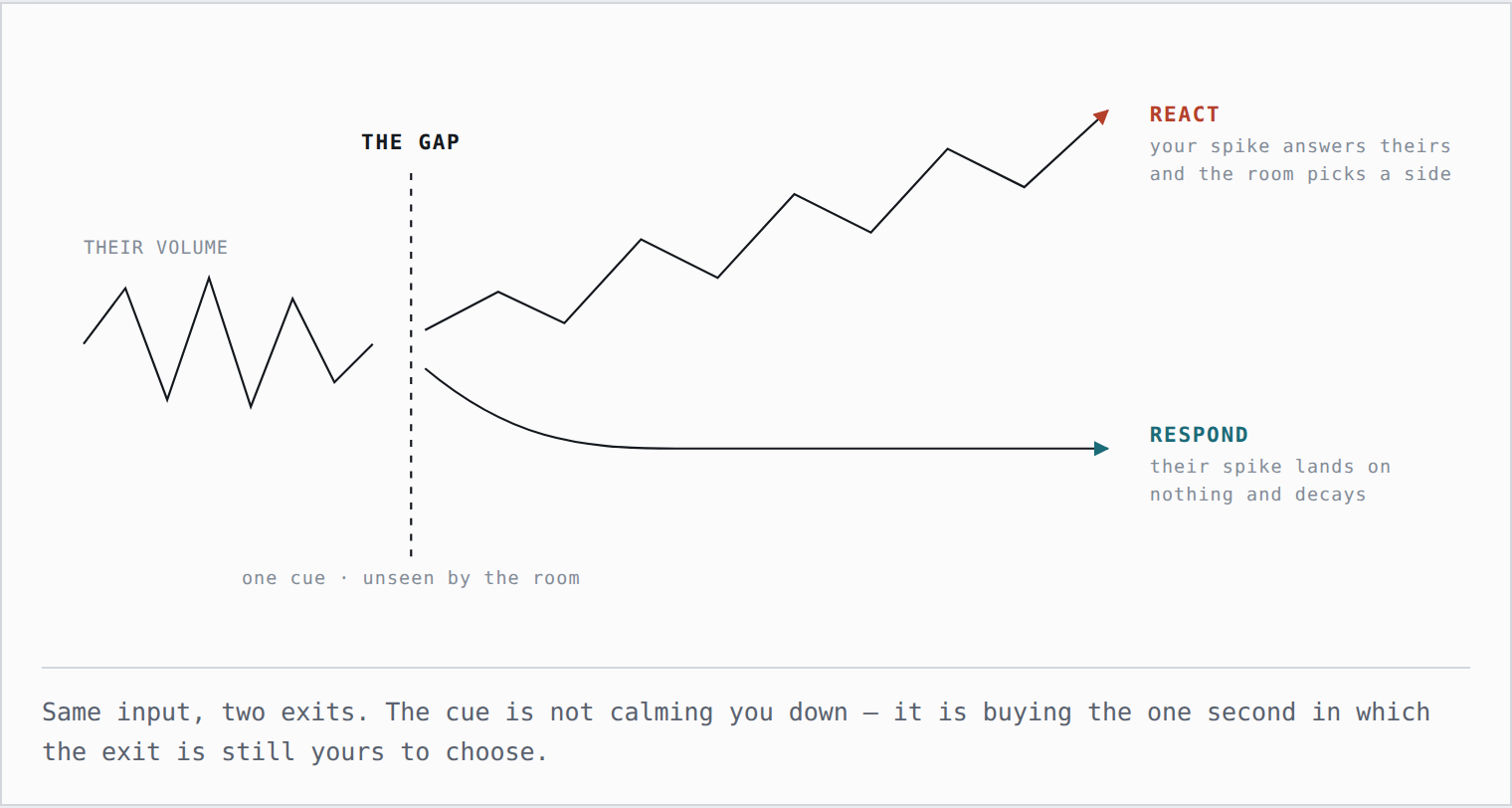
Somebody just raised their voice at you. Everything that happens next is decided in the second before you open your mouth. A reaction is automatic and it feeds the escalation, whereas a response is chosen and it starves it. The gap between those two is small but it is real, and you can access it with your body. You are trying to get your thinking brain back online before your mouth commits you.
Pick ONE physical cue and make it your default, so you are not choosing a technique while flooded. Curl your toes and release them. Press both feet flat into the floor. Rub two fingertips together. Exhale longer than you inhaled. Crumple a piece of paper you were already holding.
Avoid: careful with the loud cues. Snapping a pencil and crumpling paper are audible. In a room that is already hot, they read as anger. Keep your cue invisible: toes, feet, fingertips, breath.
Where it breaks
- You go flat instead of steady. Not reacting is not the same as not responding. Going blank for the whole meeting is stonewalling, and people read it as contempt — which escalates rather than defuses.
- You stay anchored to the wrong thing. Anchor to the business outcome, out loud if you need to: "The regulation isn't optional. What we control is the date and what we tell the customer."
2 ·Mirror
Listen for the stake · say it back · then stop talking
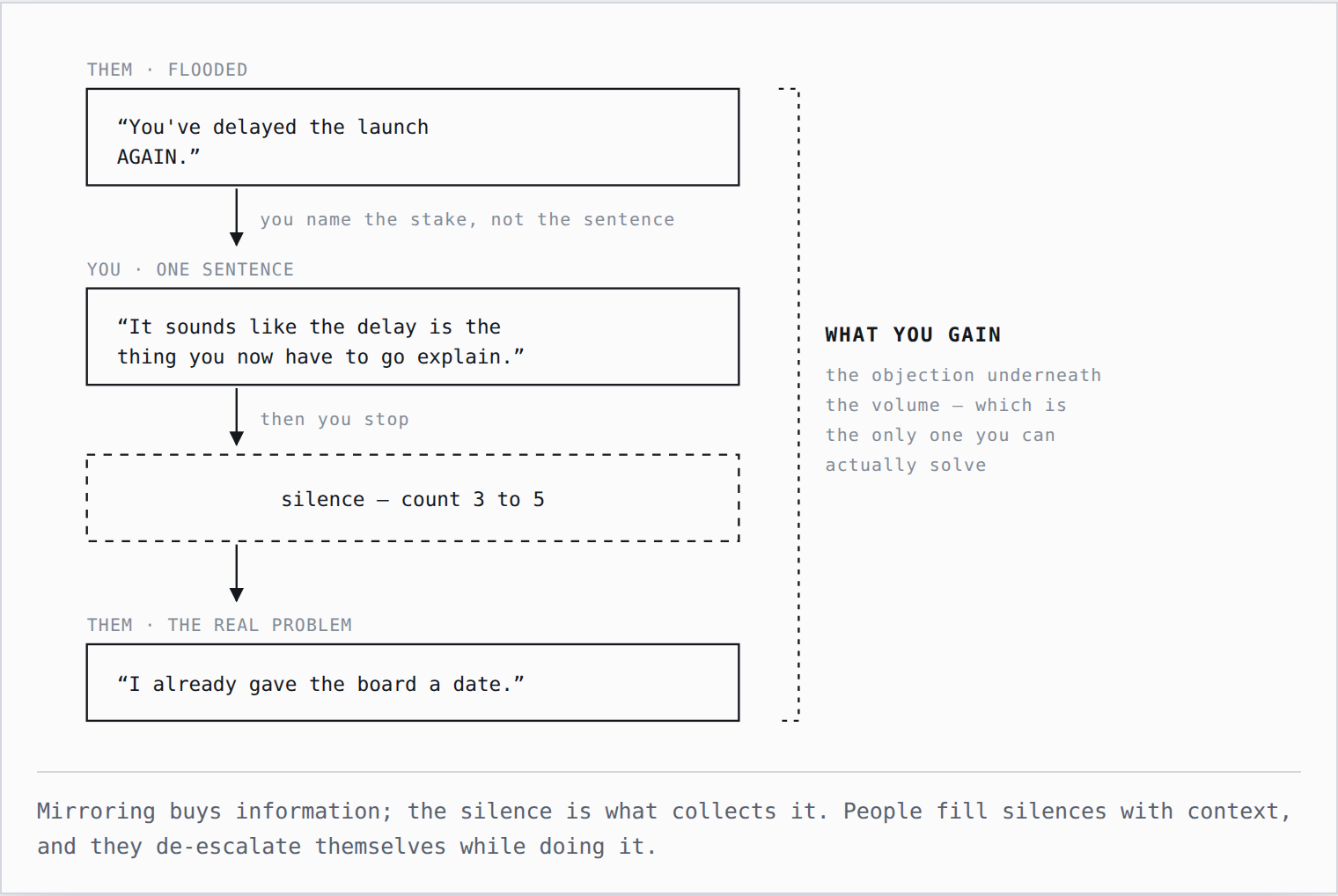
Do not agree. Do not disagree. Both put you inside their argument. Instead, hand back what you heard — especially the part they did not say out loud — and then leave a silence big enough for them to walk into.
What people shout is almost never the actual problem. "You've delayed the launch again" is rarely about the calendar. It is usually about a promise someone made to a customer, a board, or a boss, and now has to go un-make. Mirror the stake, not the sentence.
Two reps, cheapest first
- The true mirror. Repeat their last one to three words, with an upward inflection. "Delayed again?" Costs nothing, requires no insight, works when you have none.
- The label. "It sounds like…" / "It seems like…" / "So the real problem is…" Higher skill, higher return.
- Then silence. Actually count it. Three to five seconds is much longer than it feels.
Openers that backfire
- "What I hear you saying is…" — reads as a trained technique and invites "that's not what I said." It also makes the sentence about you.
- "I understand." — invites "no, you don't."
- "Let's all calm down." — has never once calmed anyone down.
- Any smile. In a hot room it reads as smug, not warm.
Where it breaks
- Tone. The same sentence delivered with a lilt is patronizing and will double the volume. Flat, low, slightly slower than your normal pace.
- You mirror the content instead of the stake. Restating the calendar back to them proves you were listening to the wrong thing.
- You fill your own silence. The single most common failure. If you talk at second two, you buy nothing.
Citation: Voss, Chris, with Tahl Raz. Never Split the Difference: Negotiating As If Your Life Depended On It. New York: HarperBusiness, 2016. Mirroring is Chapter 2, "Be a Mirror"; labeling is Chapter 3, "Don't Feel Their Pain, Label It."
3 ·Return
Give the time back · name the next time before you leave · put it in writing
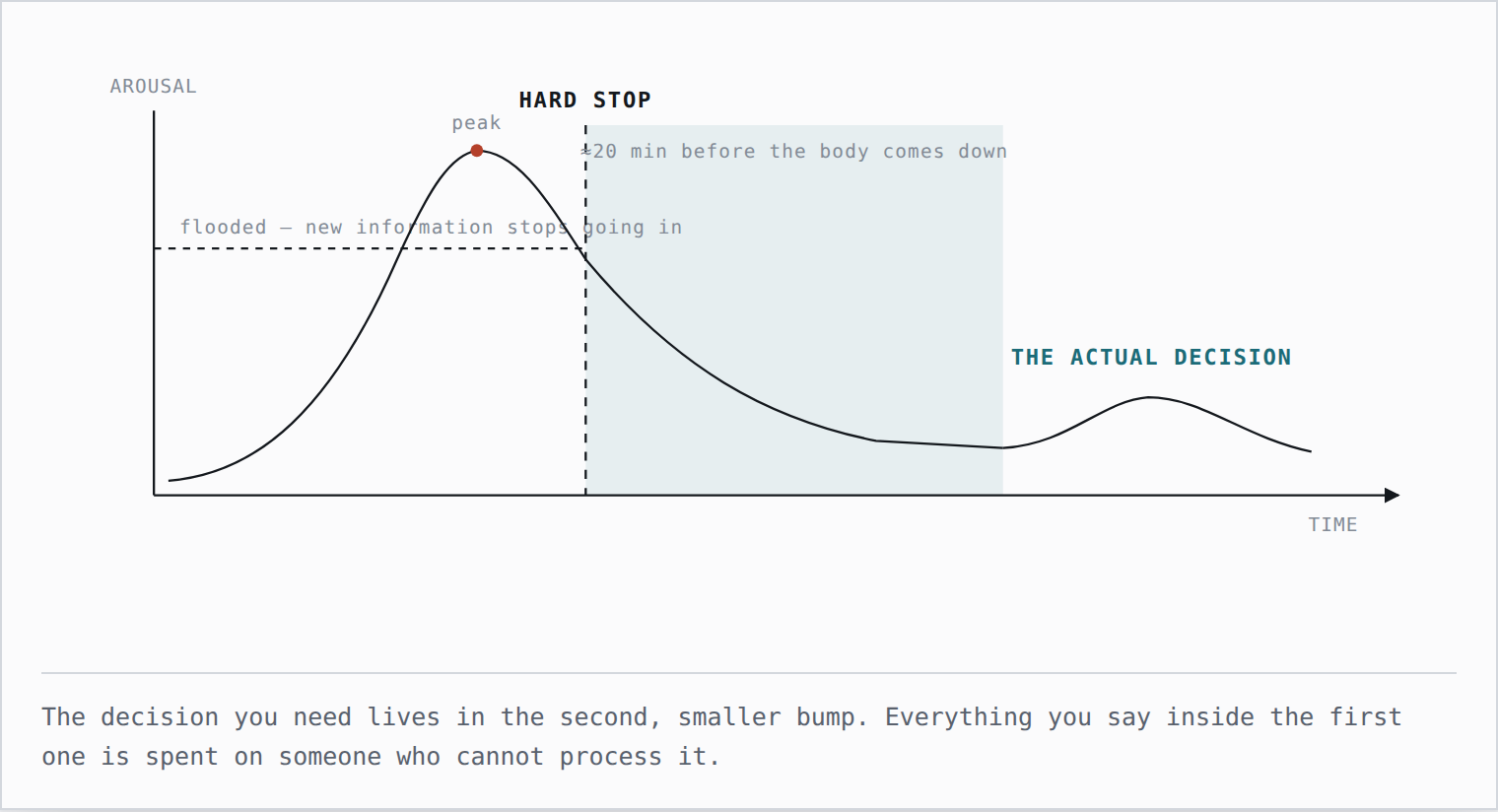
There is a point past which no technique works, because the person in front of you is not currently able to take in new information. Continuing to push for the decision inside that window is not persistence. It is negotiating with someone who cannot hear you, and it costs you the relationship you will need next quarter.
So end it — deliberately, generously, and with a specific next time attached. "Giving time back" is a native corporate move that nobody reads as retreat, and it is the most underused de-escalation tool in a calendar-driven company.
In the room
Say: "I want to get this right, and we're both hot. I'm going to give you the rest of the hour back. I'll send a time for tomorrow morning."
- Name the next time BEFORE you walk out. A "let's circle back" with no time attached reads as avoidance, and it costs you more credibility than the argument did.
In the calendar, in advance
- Schedule conversations you expect to be heated to start 25 minutes before a hard stop. The external limit does the work so you don't have to.
- Never book them as the last thing in the day. There's no wall to stop at, and nobody sleeps on it well.
In writing afterwards
- Keep the follow-up brief, informative, friendly, firm — Bill Eddy's BIFF. Facts, next step, no relitigating, no defending yourself against the accusations. Assume it gets forwarded.
Where it breaks
- You leave without a time. Then it is not a return, it is a retreat, and you have taught them that shouting ends conversations they were losing.
- You come back and open with the argument. Open with the mirror from step two instead: "You said the board already has a date. Let's start there."
- The gap is too long. Twenty minutes is physiology. Two weeks is a grudge.
What this is not for
This is a protocol for a one-off blowup between people who have to keep working together. It is not a response to a pattern.
If the same person yells at you repeatedly, the problem is not your technique and no amount of mirroring will fix it. That is a documentation-and-escalation problem: write contemporaneous notes, keep the BIFF email trail, and take it to HR or your manager.
Which step you'll drop under load
Everyone can recite three steps. Which one you drop under pressure is a function of your communication wiring, so practice the one that's yours rather than all three evenly. In my coaching work I map this with a communication-style assessment; here's the short version.
- High I fails step 2 — the silence. Talks into it, or turns the mirror into rapport repair. Rep: count to five out loud in practice until the pause stops feeling like rudeness.
- High S fails step 3. Ending the conversation feels like abandoning the person. Also the most likely to slide into genuine grey-rocking, because going flat feels safest. Rep: the exit sentence, out loud, twenty times.
- High D fails step 2 — mirroring feels like conceding ground, so they jump to solving. Rep: mirror three times before offering anything, in a low-stakes conversation this week.
- High C fails step 1 — reaches for the correction. "The regulation isn't optional" is true, and saying it at the peak doubles the volume. Rep: hold the correct fact for twenty minutes and deliver it in the return.
Sources & further reading
- Voss, Chris, with Tahl Raz. Never Split the Difference (HarperBusiness, 2016), ch. 2 "Be a Mirror" and ch. 3 "Don't Feel Their Pain, Label It."
- Goleman, Daniel. Emotional Intelligence: Why It Can Matter More Than IQ (Bantam, 1995) — origin of the "amygdala hijack."
- The Gottman Institute — flooding and the ~20-minute physiological recovery window.
- Eddy, Bill — BIFF responses and EAR statements (High Conflict Institute).
- Crisis Prevention Institute — the Integrated Experience and Rational Detachment.
- Thompson, George — Verbal Judo and the LEAPS model.
The meeting that went sideways is exactly what we rehearse.
I coach technical experts through the move from respected expert to recognized executive — real situations, no personality transplant.
Book a free discovery call Get the free field guide